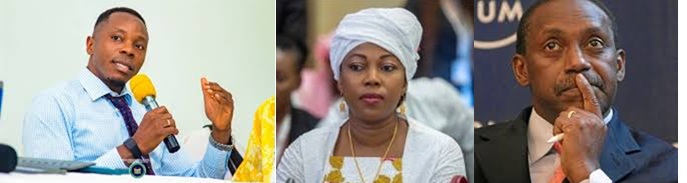
As Sierra Leone edges closer to the 2028 presidential election, political conversations have steadily shifted from retrospection on the SLPP’s two-term leadership under President Dr. Julius Maada Bio to speculation on who might succeed him as the party’s flag-bearer. Within the ruling Sierra Leone People’s Party, debates are growing around who possesses the experience, political clout, national appeal, and party loyalty to take the baton into the next phase of governance. Among the SLPP’s leading figures are Chief Minister Dr. David Moinina Sengeh, First Lady Dr. Fatima Maada Bio, Foreign Minister Alhaji Timothy Musa Kabba, and veteran international statesman Dr. Kandeh Kolleh Yumkella.
Dr. David Moinina Sengeh – The Innovation Architect
Dr. David Sengeh, Sierra Leone’s Chief Minister and a widely respected technocrat, has become one of the most visible faces of the SLPP’s modernizing agenda. With deep roots in both global academia and national governance, Dr. Sengeh brings an unusual blend of technical expertise and youthful energy to politics. A Harvard and MIT-trained innovator with accolades such as being on the Forbes 30 Under 30 list and a Senior TED Fellow, he has overseen major digital and administrative initiatives in education, technology, and public service delivery. His leadership in digital transformation, especially through the Directorate of Science, Technology and Innovation, helped expand government reach and accountability — earning him admiration from young voters and development partners alike.
Within the SLPP, Dr. Sengeh’s influence continues to grow: he chaired the party’s Constitutional Review Committee and was recently honored with a SLPP Service Award for his long-standing commitment and contributions to the party. His role in the party has often crossed beyond technocratic governance into active political stewardship, especially during internal party reforms. These strengths position him as a credible future leader who could balance modern governance with the SLPP’s social democratic values.
However, challenges remain. Sengeh’s technocratic appeal might not automatically translate into broader electoral support in rural regions where grassroots political networks and constituency outreach matter deeply. His transition from policy innovator to national political front-runner would require deepening his political roots beyond the Freetown glow and urban policy circles.
Dr. Fatima Maada Bio – The First Lady with a National Campaign Platform
First Lady Dr. Fatima Maada Bio commands widespread public visibility that few SLPP figures can match. Through her official office she has championed issues central to women’s and youth welfare — including menstrual hygiene programs, combating gender-based violence, and advocating for girls’ education. Her leadership roles extend to continental platforms: she was inaugurated as President of the Organization of African First Ladies for Development (OAFLAD), giving her stature beyond Sierra Leone.
In Africa, it is not uncommon for First Ladies to leverage their public profile into political ambitions; figures such as Liberia’s Ellen Johnson Sirleaf and (to a lesser extent) Uganda’s Janet Museveni have shown that spouses of sitting presidents can build viable political platforms. But Fatima Bio’s ambitions would need careful navigation of constitutional and public expectations in Sierra Leone, where the office of the First Lady is not established by statute and lacks direct political authority.
Her strength lies in social advocacy that resonates with women and youth — powerful voting blocs. Yet, her close public association with the incumbent presidency means that any bid for national office could be interpreted as a continuation of the status quo, making it imperative that she articulates a distinct policy vision beyond the current administration’s record.
Alhaji Timothy Musa Kabba – The Diplomat with Development Credibility
Unlike the other prospective leaders, Alhaji Timothy Musa Kabba brings to the table long experience in both economic and global relations sectors. Educated at Fourah Bay College and seasoned as a petroleum engineer and diplomat, Timothy Kabba served as Sierra Leone’s Minister of Mines and Mineral Resources before his current appointment as Foreign Minister in 2023. His fluency in English, French, and Russian and extensive work in international energy and diplomatic arenas have earned him respect among professional and international audiences.
Within the SLPP and government hierarchy, Timothy Kabba’s role is less overtly political and more technocratic, but this has its advantages. His stewardship of Sierra Leone’s foreign policy — especially at a time when the country seeks deeper international partnerships and investment — positions him as a candidate capable of projecting Sierra Leone’s interests on the global stage. Yet like Dr. Sengeh, his major challenge would be building the grassroots political network essential for securing a party’s nomination and winning national elections.
Dr. Kandeh Kolleh Yumkella – The Global Statesman Returning Home
Dr. Kandeh Yumkella’s career stands apart from his SLPP colleagues due to his extensive international experience. A former United Nations Under-Secretary-General and ex-Director-General of the United Nations Industrial Development Organisation (UNIDO), Dr. Yumkella is globally respected for his work on energy, climate change, and sustainable development. After a period leading his own party — the National Grand Coalition (NGC) — he officially returned to the SLPP in October 2023.
Dr. Yumkella’s stature as a global expert and seasoned economist gives him unique appeal, particularly among voters looking for visionary leadership and strong international advocacy. However, his reintegration into the SLPP has not been seamless. Some party heavyweights have publicly questioned whether he is fully prepared to climb the internal ladder after years outside the party fold, suggesting he may need time to rebuild trust and buy-in among SLPP grassroots.
Suitability and Party Dynamics
Comparing these four figures highlights contrasting strengths and challenges. Dr. Sengeh is the modernizer with strong youth appeal whose watchword is Inclusive Radicalization; Fatima Bio embodies social advocacy and national symbolism and has formed the ‘EBEMA” movement; Timothy Kabba represents diplomatic and technical depth; while Dr. Yumkella brings unparalleled international experience. Each would fulfill different voter expectations: innovation, social change, global engagement, and diplomatic pragmatism.
Yet in SLPP politics, success requires more than individual profiles. Party hierarchy, loyalty to internal processes, and grassroots engagement remain critical. A flag-bearer must unite diverse factions — from rural elders to urban professionals — while articulating a vision that transcends personalities to inspire national confidence. Whether any of these leaders can achieve that remains a question that will define the SLPP’s path to 2028.