By Sahr Ibrahim Komba
Sierra Leone’s Attorney General and Minister of Justice Alpha Sesay Esq has emphasized that climate change is not merely an environmental concern but a fundamental human rights crisis, affecting the rights to life, food, health, housing, and dignity.
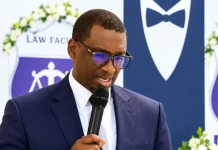
Speaking at the National Conference on Human Rights and Climate Change held at the Bank Complex, the Attorney General and Minister of Justice described integrating a human rights-based approach into climate mitigation and adaptation measures as both a legal and moral imperative. He warned that climate change is a present threat in Sierra Leone, with rising temperatures, erratic rainfall, frequent floods, landslides, and coastal erosion threatening agriculture, water security, and livelihoods.
By 2050, he noted, the country could lose 26.4 square kilometers of coastline, affecting 2.3 million coastal residents, and divert critical resources from healthcare and education, worsening poverty and inequality.
Highlighting Sierra Leone’s global leadership in climate justice, the Attorney General recalled the country’s participation before the International Tribunal for the Law of the Sea (ITLOS) and the International Court of Justice (ICJ), asserting that inaction on climate change constitutes a violation of human rights. He described these legal interventions as aimed at securing cooperation, financial, and technical support for vulnerable nations rather than charity.
The Minister also referenced international frameworks recognizing the link between climate change and human rights, including UN Human Rights Council resolutions, rulings by the Inter-American Court and Commission on Human Rights, UNICEF reports, and the Paris Agreement, emphasizing that governments must adopt policies consistent with human rights obligations.
The Chairperson of the Human Rights Commission of Sierra Leone (HRCSL), Madam Patricia Narsu Ndanema, welcomed participants to the Commission’s first national conference on the subject. She highlighted the HRCSL’s efforts, including the establishment of the Directorate of Climate Change and Information Services in 2022 and partnerships with government agencies and the Danish Institute for Human Rights.
The Commission has conducted nationwide assessments across 27 communities, evaluating climate-related laws and policies from a human rights perspective, producing a report to guide national policy.
Madam Ndanema emphasized that the conference seeks to examine climate impacts through a human rights lens, promote participation, accountability, equality, and non-discrimination in policy-making, and produce actionable recommendations for climate mitigation and adaptation strategies. She called for greater partnership and support for the Commission’s climate initiatives.
Vice Chairman of the HRCSL, Victor Landana Esq, noted that while disasters occur naturally, climate change is largely driven by human activity, including fossil fuel use, deforestation, and industrialization.
He stressed that although Sierra Leone contributes minimally to global emissions, it remains one of the most vulnerable nations. He urged the adoption of a people-centered, human rights-based approach, ensuring participation, inclusion, and access to decision-making, aligning with recent ICJ advisory opinions.
Speaking on behalf of civil society, Alphonso Gbani of Human Rights Defenders reinforced that climate change violates the rights of farmers, women, and children, and called for policies that recognize affected communities as active rights holders. He highlighted legal obligations under the Universal Declaration of Human Rights, International Covenant on Economic, Social and Cultural Rights, the African Charter on Human and Peoples’ Rights, and Sierra Leone’s Constitution to protect the environment.
The conference also featured remarks from Thomas O. Sesay, President of the Artisanal Fishermen Union, who highlighted the severe impacts of climate change on coastal communities. He cited frequent floods, landslides, rising seas, and coastal erosion destroying homes, mangroves, fish landing sites, and heritage areas. He stressed that warming temperatures threaten fisheries and livelihoods, while island communities such as Turtle, Plantain, and Sherbro face permanent land loss.
He called for urgent support for coastal protection, mangrove restoration, and resilient livelihood programs, emphasizing that for Sierra Leoneans, climate change is a matter of human rights, survival, and future prosperity.
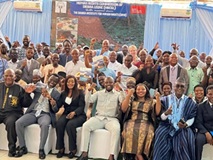
The conference concluded with a call to translate human rights principles into actionable national climate policies, ensuring that Sierra Leone’s response to climate change is both scientifically sound and morally grounded.