
By Sahr Ibrahim Komba
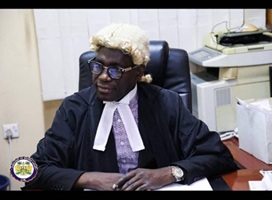
In every generation, there arises an individual whose presence in academia and public life becomes a defining force one who not only teaches but transforms; who not only interprets law and communication but redefines them. Justice Abou Bhakarr M. Binneh-Kamara is such a man. A towering intellectual figure, a principled jurist, and a philosophical reformer, he spent decades shaping the moral, legal, and academic consciousness of Sierra Leone and continued to do so with unwavering commitment and startling brilliance.
To speak of Justice Binneh-Kamara is to speak of a man whose influence is deeply etched across lecture halls, courtrooms, boardrooms, and minds. It is no exaggeration to say that most lecturers, tutors, and even senior mentors in the fields of law and communication in Sierra Leone are, directly or indirectly, his students and disciples. His imprint is felt far beyond the institutions he served; it is rooted in the very DNA of the country’s legal and academic traditions.
Often hailed as “the most educated man in Law and Communication in Sierra Leone dead or alive,” Justice Binneh-Kamara never sought validation through titles or accolades. His brilliance spoke for itself. His intellectual depth was matched only by his humility and signature sense of humor. He once said, “I want to be different from the ordinary academic doctor not just with one Ph.D., but two: one in Law and one in Communication for the fityai.” That fityai that hunger to excel, to outthink, to stand apart is what set him apart for decades.
In his classroom, books were rarely needed. His lectures were delivered extemporaneously, drawn from a mental library unmatched in both depth and clarity. “I have over 50 arguments for this issue,” he would often say, “but I’ll just give you three. I forge ahead.” And with that, he would take students on an intellectual journey that seamlessly blended classical philosophy, African wisdom, legal theory, and real-world application.
When teaching Law, he insisted it was the best discipline in the world. When teaching Communication, the same praise was given. It’s not inconsistency it’s conviction. To him, every discipline must be taught with complete immersion and respect. In his words: “There’s no boring subject. There are only boring lecturers.”
And he was certainly never one of them. He pushed students beyond their limits and would sometimes say, “I am not here to fail you, but to confirm your failure.” This statement pushed us to form what we called the “Study Camp.”
Our energetic Class Madam, Ann Marie, was ever ready to engage Justice Binneh in intellectual conversation just to bring our legend to the Mass Communication class, despite his busy schedule as a Judge of the Superior Court of Judicature.
When he came to class, he would ask, “Where is your class rep? Her calls are so annoying!” and the entire class would burst into laughter.
Ann! Thanks for taking the academic missiles on our behalf.
Justice Binneh! Please deliver our heartfelt greetings to Madam Gloria Palmer (Mummy Palmer) and Madam Bernadette Cole the “godest” of our beloved private school.
You have left an indelible legacy in our beloved nation, Sierra Leone.
“I forge ahead.”
Justice Binneh-Kamara’s intellectual excellence was matched by his unshakable moral compass. He is best known for his famous maxim:
“When a man loses money, he loses nothing.
When he loses health, he loses something.
But when he loses his integrity, he loses everything.”
To him, integrity was non-negotiable whether in public life, academia, or private conduct. He often reminded students and officials alike that credentials mean nothing without good character.
In a time when moral relativism and compromise are common, Justice Binneh-Kamara remained a resolute voice for honesty, ethical consistency, and national conscience. He did not just teach integrity he lived it. He warned young people never to trade their values for temporary gains and challenged public servants to rise above corruption and self-interest.
“You can have a degree,” he often said,
“but without discipline and ethics, you’re a decorated failure.”
Justice Binneh-Kamara consistently advocated for systemic reform not just in law and governance, but in thought.
“You cannot reform a nation,” he often said, “without reforming the way people think.”
He believed that Sierra Leone’s challenges were not only structural, but cultural. In his view, genuine national development demands moral courage, intellectual honesty, and a deep cultural shift.
He spoke candidly about the weaknesses in Sierra Leone’s justice system, the commodification of education, and the erosion of ethical leadership. Yet, he remained hopeful because he believed in the power of ideas, and in the ability of people to change when exposed to truth. His classes were not just lectures; they were platforms for critical reflection, moral challenge, and social reawakening.
One of the most remarkable aspects of Justice Binneh-Kamara’s teaching was his fearless and respectful demystification of religious texts. With a deep command of both the Quran and the Bible, he wove theology into his philosophical and legal arguments with grace and boldness. He was known to quote both texts fluently, drawing parallels between scriptural teachings and contemporary issues.
But he did not quote scripture for theatrics or shallow moralism he interrogated the meaning. He pushed students to reflect on the context, intent, and spirit of the verses not just their literal reading.
For example, he would say:
“You don’t read the Bible or Quran like a storybook. You read to understand the philosophy of life behind the verse.”
He boldly challenged hypocrisy masked as piety and frequently warned against using religion as a tool for manipulation or control. His teachings encouraged believers to seek truth with reason not blind conformity.
“True religion,” he would say,
“must not suspend your intellect. It must deepen it.” Always look at the flip side of issues and make unbiased judgments.
Despite his intellectual wealth and high status, Justice Binneh-Kamara lived a life of simplicity. He was known for saying:
“I see no reason to build or buy a house. I want to leave this world with a clean conscience, not property.”
When he returned from overseas travel unlike others who flaunted material goods he famously remarked:
“The only thing you would see me with is book.”
That statement captured the essence of a man devoted not to possessions, but to purpose to education.
Justice Binneh-Kamara was not only a judge or professor; he was a national asset, a beacon of truth, and a pillar of wisdom in Sierra Leone. The number of professionals, public servants, journalists, and legal minds he mentored is immeasurable. His commitment to building a generation of thinkers and ethical leaders is perhaps his greatest legacy.
Those fortunate enough to sit under his tutelage often describe it as a life-changing experience. He did not just teach content he awakened minds and elevated consciences.
As Sierra Leone and the wider region continue to face critical challenges in justice, governance, and education, the example of Justice Binneh-Kamara serves as a compass. His voice both bold and wise reminds us that a nation cannot be transformed by policies alone, but by principled people guided by truth, intellect, and unwavering integrity.
Justice Abou Bhakarr M. Binneh-Kamara is, without doubt, one of the finest minds and noblest spirits Sierra Leone has ever produced.
His impact is generational, his wisdom timeless, and his legacy, eternal.
Rest in Peace, our Academic Legend.


