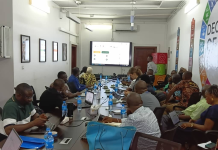
The Produce Monitoring Board (PMB) has announced significant progress in strengthening Sierra Leone’s position in the global coffee and cocoa sectors, citing improved international credibility, advances in export compliance, and growing market opportunities for farmers and exporters.
Speaking during a press briefing under the theme “Restoring Credibility, Delivering Compliance,” PMB Executive Chairman Raymond Katta outlined what he described as a year of measurable achievements aimed at transforming the country’s agricultural export industry.
The Chairman said Sierra Leone has successfully settled all outstanding obligations of €299,224 Debt to the International Coffee Organization (ICO), the International Cocoa Organization (ICCO), and the Inter-African Coffee Organization (IACO), restoring the country’s full participation in key international commodity bodies.
According to the Executive Chairman, the move has reinstated Sierra Leone’s voting rights, renewed access to technical cooperation programmes, and strengthened confidence among international partners and investors.
“Credibility matters in international trade. Today, Sierra Leone is once again fully engaged and respected within the global coffee and cocoa community,” the Chairman said.
In another major milestone, Sierra Leone was selected as the IACO Country Spotlight for 2026, bringing international attention to the country’s unique and climate-resilient Coffea stenophylla, a rare coffee species indigenous to Sierra Leone.
The recognition is expected to increase global visibility for Sierra Leone’s coffee industry, attract new buyers, and improve market opportunities for farmers, particularly in producing districts such as Kenema, Kailahun, and Kono.
PMB also reported significant progress toward compliance with the European Union Deforestation Regulation (EUDR), which comes into force in December 2026 and will require exporters to demonstrate that commodities entering the EU market are not linked to deforestation.
The Chairman disclosed that it has completed a pilot project involving the mapping of 163 farms using GPS polygon technology, integration of geolocation and deforestation-risk data, and testing of compliance systems.
Officials said the pilot successfully demonstrated that EUDR implementation is both practical and scalable, paving the way for a nationwide traceability programme expected to cover approximately 40,000 farmers.
“Sierra Leone is preparing to meet compliance requirements and build trusted, transparent supply chains,” the Chairman stated.
He noted that growing global demand for compliant and traceable agricultural commodities presents significant opportunities for Sierra Leone.
Under the EUDR framework, deforestation-free coffee and cocoa sources are expected to become increasingly valuable in European markets, while the African Continental Free Trade Area (AfCFTA) offers access to a market of approximately 1.4 billion consumers across 54 countries.
The Executive Chairman said Sierra Leone’s coffee and cocoa sectors are well-positioned to benefit from these developments, particularly as buyers seek reliable, traceable, and sustainably produced commodities.
Beyond market access, the Chairman highlighted internal reforms aimed at strengthening governance and accountability. These include revised Standard Operating Procedures, enhanced digital inspection and monitoring systems, improved sanitary and phytosanitary compliance frameworks, and stronger fiduciary and procurement controls.
The Chairman emphasized that sustainable compliance begins with strong institutions and reaffirmed PMB’s commitment to transparency and accountability.
“We maintain a zero-tolerance approach to weak governance and accountability failures,” he said.
While acknowledging challenges related to financing compliance, farmer awareness, exporter readiness, and infrastructure constraints, Mr Katta said practical solutions are already being implemented. These include expanded farmer sensitization campaigns, targeted exporter training, strategic partnerships, and the use of offline-enabled mapping technologies to overcome connectivity challenges.
Looking ahead, the Board pledged continued support for exporters seeking to access both European and African markets through training on sanitary and phytosanitary standards, Rules of Origin requirements, and regional trade regulations.
The Executive Chairman described 2026 as “the Year of Compliance and Accountability,” calling on farmers, exporters, development partners, and investors to work together in building a more competitive agricultural export sector.
“Stronger systems, better markets and higher-value opportunities are the direction of travel,” he said.