
Mr. Joshua Nicol, a lecturer with the University of Sierra Leone Fourah Bay College Department of Journalism and Media Studies has expressed shock and bewilderment after hearing about the Gambaga witches camp located in the North East Region of Ghana. People could be labelled witches just because someone dreams about them carrying out some ‘seemingly’ witchcraft activity.
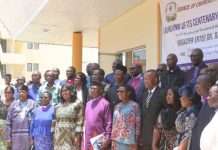
The lecturer was speaking on Wednesday 5th April, 2023 at a one day regional high-profile round table on inclusive journalism for senior media professionals and editors at the Monarch Hotel East Legon in Accra, Ghana. The roundtable was coordinated by Media Platform on Environment and Climate Change (MPEC/Ghana) together with Minority Rights Groups Africa (MRGA) with funding from the European Union. The meeting which attracted participants from Sierra Leone, Senegal and hosts Ghana dwelt on the theme “Conflict, migration and minority rights: Media perspectives and community livelihoods”.
The keynote speaker, Prof. Amin Alhasan, who is the Director General of the Ghana Broadcasting Corporation dilated on the causes of conflicts and human rights. He stressed that conflicts are mostly between the social and the psychic. In other words what one thinks about one self and what society thinks about that individual. He emphasized the relationship between minority reporting and that of climate change and posited that human activities impact people’s lifestyle and inaccessibility to managed facility and have to depend on what nature supplies. These issues, he said replicate themselves in the region and encouraged media professionals to go in search of stories of minority groups noting that if they don’t tell the story no one will hear.
“You have the power of the media to talk about minorities. You may never tell when you will become a Victim,” he warned.
A case study of the Gambaga Witches camp located in the North East Region of Ghana formed the bedrock of discussions during the engagement. It was revealed that women, mostly widows accused of being alleged witches in the northern parts of Ghana are normally sent away far from their original communities to a designated area in the Gambaga a community in the North East Region, an action most human rights activists have described as torture against their human rights.
The treatment of these aged women has not given Ghana as a country any good image on the international front whenever is brought as an issue for discussion. It was at that point that the University lecturer from Sierra Leone expressed shock that such action against humanity was going on in Ghana because of people’s imagination and perception.
“I think, the government should have the courage and intervene, take affirmative action, educate the people to let them know that all those things are fantasies. Because you dreamt about your neighbors the next morning you tagged your neighbor a witch.They need more civic education and public education”. He stressed that many women have been murdered or maimed after accusations of witchcraft
On his part, Donald Theo-Harding, Chairman of the Guild of Newspaper Editors Sierra Leone who was part of the delegation from Sierra Leone said that unlike Sierra Leone where people, especially poor, old, sick or diseased women have been accused of witchcraft, Ghana has institutionalized the stigma. He expressed delight that an Anti-Witchcraft Bill was being tabled in Ghana and that the accusation of witchery would soon be a thing of the past.
The erstwhile president of Women in the Media Sierra Leone (WIMSAL) Femi Coker was incensed to learn that over 90% of the accused witchcraft persons were women. She referred to the accusations and treatments as Gender Based Violence. “Violence against women is deeply rooted in patriarchy and an imbalance of power which often puts women at a disadvantage, making them vulnerable. The violence and discrimination suffered by women is a key barrier to the realisation of their rights, and to the achievement of social justice,” she fumed.
The Media Reform Coordinating Group MRCG) coordinated the Sierra Leone delegation and was led by Dr. Francis Sowa the National Coordinator of the MRCG.