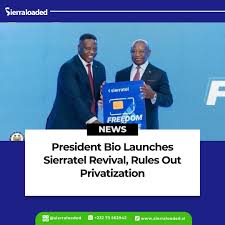
The Government of Sierra Leone’s newly announced partnership between Sierratel and Africell is being presented as a bold rescue plan, one that promises to revive a struggling national telecom operator without placing additional strain on taxpayers. Officials have framed the arrangement as a transition to a Modern Mobile Virtual Network Operator (MVNO) model: leaner, more efficient, and commercially viable.
Yet beneath this optimism lies a series of critical questions around transparency, due process, and the long-term implications for Sierra Leone’s telecom sovereignty.
On paper, the deal appears compelling. Sierratel retains full government ownership, while Africell provides infrastructure, technical expertise, and upfront investment. The state avoids new financial commitments, and service delivery is expected to improve rapidly.
However, this raises a fundamental issue: if Africell controls operations, infrastructure, and service delivery, what does “ownership” truly mean in practice?
Ownership without operational control risks becoming largely symbolic. While the state may retain the license and brand, Africell effectively becomes the engine of the business shaping how services are delivered, how efficiently they run, and potentially how competitive they are in the market.
A central concern is whether the agreement underwent adequate institutional scrutiny. Given that Sierratel is a national asset, a long-term operational concession arguably warrants legislative oversight by Parliament of Sierra Leone.
Key questions remain unanswered:
- Was Parliament consulted or did it approve the agreement?
- Were procurement laws followed under the Public Procurement Act?
- Was the partnership competitively tendered, or was Africell selected through direct negotiation?
- Were other operators, including Orange Sierra Leone and QCell, given a fair opportunity to bid?
Without clarity on these issues, the government’s assurances of transparency remain incomplete.
The government maintains that “this is not privatization.” Technically, that may be correct. However, in functional terms, the distinction is less clear. When a private company provides capital, runs the network, and drives operational decisions, the arrangement begins to resemble a form of managed privatization even if ownership remains with the state on paper.
This raises a broader policy concern: is Sierra Leone setting a precedent in which state-owned enterprises become nominal entities, while private firms control the real economic value? If replicated across sectors, such a model could gradually shift economic power away from public institutions without formal privatization debates.
The partnership is also likely to reshape the telecommunications landscape. The MVNO model has potential benefits, including improved service offerings, pricing flexibility, and expanded rural connectivity. However, it also carries risks:
- Granting Africell a structural market advantage
- Blurring the line between regulator, operator, and partner
- Creating market distortions if oversight is weak
Regulatory neutrality becomes a critical issue. Can the government effectively regulate a sector in which it is both an owner through Sierratel and a partner via Africell’s operational role?
Labour concerns also deserve attention. The agreement reportedly includes provisions to address over $6 million in staff liabilities, a positive step if fully implemented. However, questions persist:
- What guarantees ensure these payments will be honoured?
- Are workers adequately protected under the new structure?
- Will restructuring result in job losses over time?
Without legally binding safeguards, such commitments risk remaining aspirational.
Oversight mechanisms cited in the agreement such as Key Performance Indicators (KPIs), independent audits, and government control over pricing and strategy are important, but only if they are transparent and enforceable.
Critical accountability questions include:
- Who will conduct the audits, and will reports be made public?
- What penalties apply if performance targets are not met?
- Is there a clear exit clause that protects national interests?
In Sierra Leone’s governance environment, strong frameworks often exist on paper but falter in implementation.
Minister of Communication, Technology and Innovation, Salima Bah, has indicated that the arrangement will involve a new Managing Director and a separate management structure distinct from Africell. While this may introduce a layer of operational independence, she also confirmed that Africell will oversee management processes reinforcing concerns about where real control lies.
The Minister acknowledged the risks inherent in the partnership but emphasized that provisions are in place to protect the Sierratel brand. Nonetheless, public skepticism remains high, particularly given that Sierratel and Africell were once direct competitors. For many observers, this raises the possibility that the deal could enable Africell to absorb a former rival under the guise of partnership.
Recent developments appear to support concerns about shifting market dynamics. Within days of the agreement, Africell announced expanded 4G coverage across multiple districts, an indication that the partnership may already be strengthening its market position.
Some Sierra Leoneans argue that the government should instead pursue a locally driven revival strategy, similar to the restructuring of the National Petroleum Company, leveraging domestic investment and existing infrastructure. Others have called for the government to revisit the agreement entirely.
Public-private partnerships (PPPs), by design, are governed by a structured framework of laws, policies, and contracts. In Sierra Leone, the Public-Private Partnership Act provides the legal basis for such arrangements, supported by procurement regulations, financial oversight from the Ministry of Finance, and sector regulation by the National Communications Authority.
These frameworks are intended to balance private sector efficiency with the public interest through transparency, competition, and accountability. The effectiveness of the Sierratel Africell partnership will ultimately depend on how rigorously these principles are applied.
This deal is more than a telecom transaction; it is a test case for how Sierra Leone reforms struggling state-owned enterprises. If managed well, it could restore confidence in PPPs, accelerate digital transformation, and improve service delivery nationwide. If mismanaged, it risks entrenching private dominance, undermining competition, and weakening accountability over national assets.
The question, therefore, is not simply whether Sierratel survives, but on whose terms, under what scrutiny, and with what long-term consequences for Sierra Leone’s economic sovereignty.
Until these questions are clearly addressed, the partnership remains as much a political gamble as it is a commercial strategy.