
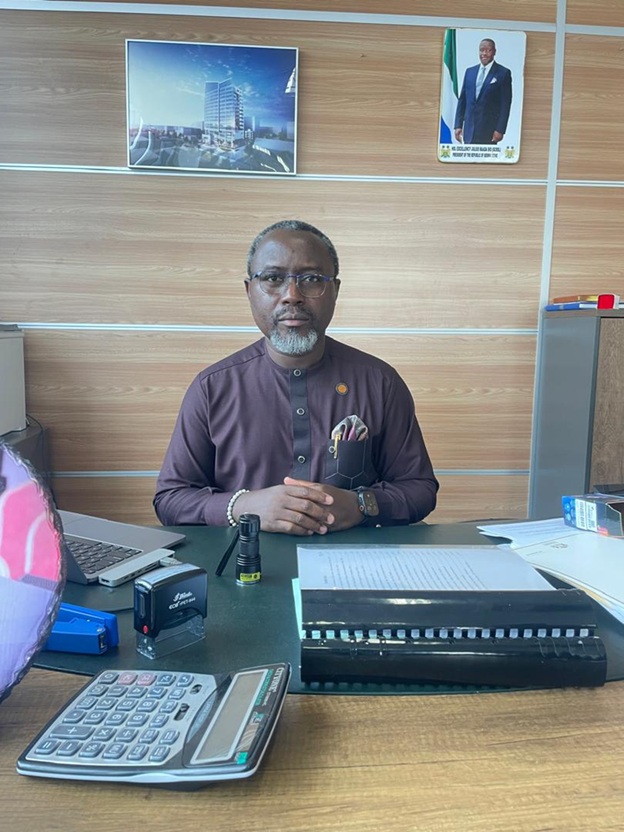
The Chief Administrator (CA) of the Freetown City Council (FCC), Mr. Rahman Tom Farmer, has firmly rejected allegations of illegal staff recruitment, insubordination to the Mayor, and misconduct in the management of council finances and assets, describing the claims as false, misleading, and politically motivated.
Speaking to the media, Mr. Farmer explained that staff recruitment and transfers do not fall under his authority but are the statutory responsibility of the Local Government Service Commission (LGSC), as clearly outlined in the Local Government Act.
“It is completely untrue to say that I recruit staff,” he said. “Core staff recruitment and transfers are handled by the Local Government Service Commission, not the Office of the Chief Administrator.”
He clarified that FCC staff are categorized into two groups: core staff—such as the Chief Administrator, Deputy Chief Administrator, Finance Officer, and Planning Officers—who are recruited and transferred by the LGSC, and support staff who operate under the internal council structure.
Addressing claims that he frequently ignores the Mayor’s instructions, Mr. Farmer said there has been no personal confrontation between him and the Mayor. He stressed that his responsibility as Chief Administrator is to act strictly within the law and established procedures.
“I did not come to Freetown City Council to create conflict,” he stated. “The conflicts existed long before I arrived. My duty is to restore professionalism and ensure lawful administration.”
Mr. Farmer referenced an Administrative Inquiry Report covering FCC operations from 2018 to 2023, which identified longstanding institutional challenges, including mistrust between political leadership and administrative staff. The report also cited the creation of the Mayor’s Delivery Unit (MDU), which operates parallel to the council’s administrative structure, as a major contributor to dysfunction within the council.
According to Mr. Farmer, his main area of disagreement with the Mayor relates to accountability and transparency, particularly in projects implemented through the MDU. He disclosed that he formally requested documentation for several projects, including Memoranda of Understanding (MOUs), contracts, funding details, and project-linked bank accounts, but received no response.
“As Chief Administrator and vote controller, I am required by law to have copies of contracts, MOUs, and project details,” he said. “I cannot supervise or account for projects for which I have no documentation.”
He cited projects such as the Central Business District (CBD) Regeneration Project, climate-related initiatives, and other externally funded programmes where, according to him, the FCC has not been provided with official agreements.
On reports that he recently stopped signing financial documents, Mr. Farmer confirmed the action but explained that it was taken in compliance with the law following the suspension and transfer of the council’s Finance Officer by the LGSC.
“It would be unlawful for me to countersign financial documents with a suspended officer,” he said. “Doing so would expose both the council and myself to serious audit and corruption risks.”
He added that he proposed an interim arrangement for the Council Accountant to sign financial documents until a new Finance Officer is appointed, but the proposal was rejected.
Responding to allegations surrounding a missing FCC low-bed vehicle, Mr. Farmer said he immediately reported the matter to the police.
“I officially wrote to the Criminal Investigation Department (CID) to commence investigations. Arrests have been made, and the matter is still under investigation,” he confirmed, while denying any involvement in bailing suspects, noting that such decisions fall solely under police authority.
Mr. Farmer also addressed concerns about council priorities, including tree-planting initiatives, noting that while environmental protection remains important, the council must also focus on urgent municipal needs such as markets, schools, sanitation services, and public toilets.
He urged all stakeholders to focus on implementing the recommendations of the Administrative Inquiry Report, which he believes offers a clear pathway to resolving ongoing tensions within the council.
“This is a law-based country,” he concluded. “Leadership must respect institutions and processes. If we follow the law and implement the inquiry’s recommendations, there will be no conflict.”
In a related response, the Chief Administrator rejected further allegations of administrative obstruction, reiterating that his actions are guided by due process and good governance. He acknowledged that while many councillors perform their duties responsibly, a few have interfered in administrative functions by issuing instructions to staff and involving themselves in procurement and management matters—issues documented in the Administrative Inquiry Report, whose recommendations remain unimplemented.
On the suspension of the council’s Legal Officer, Mr. Farmer described the action as procedurally flawed, explaining that it occurred during an ongoing internal land investigation and without his knowledge, contrary to established human resource guidelines. He stressed that the concern was not about wrongdoing, but about the failure to follow due process.
He also dismissed claims that the Legal Officer was improperly recruited, noting that the officer has held a valid appointment, performed official duties, and received salary payments since 2020. He clarified that the in-house Legal Officer works alongside the council’s external legal retainer, Gabankor Chambers, and serves as the first point of contact on legal matters.
Reaffirming his position, Mr. Farmer said he remains committed to safeguarding the council’s finances and administrative integrity and will continue to act within the law, regardless of political pressure.