By Sahr Ibrahim Komba
Activities around Sierra Leone’s coastal communities are very pathetic, affecting the future of many young people, especially girls. In these struggling communities, many children are forced to make a painful choice: stay in school or drop out and work to survive.
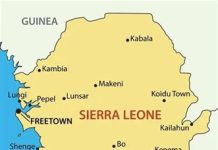
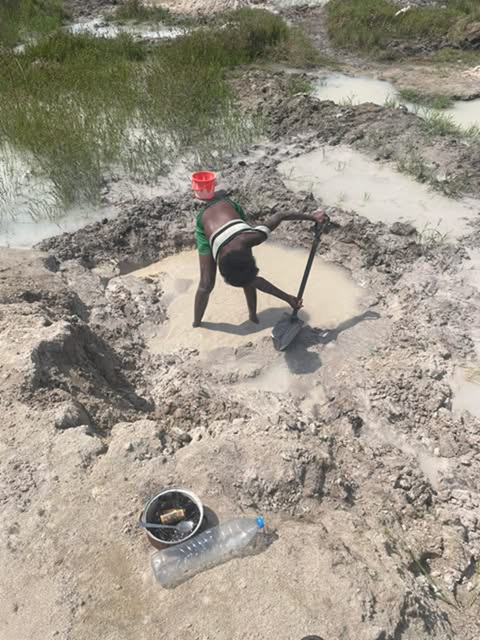
In Makoray Village, on the outskirts of Waterloo, instead of the sound of school bells, one can hear the scraping of shovels in wet sand. Seventeen-year-old Isatu Bangura stands knee-deep in swamp water, washing sand under the hot sun. Beside her is 18-year-old Zainab Kallon. Both girls should be in school preparing for their future, but instead, they are working in the dangerous world of sand mining.
“I come here to raise money for my admission notice/slip and lesson fees,” Isatu says quietly. She is preparing to take the West African Senior School Certificate Examination (WASSCE), which is important for entering university. But the cost is too high for her family.
“Admission notice costs Le400, lesson fees Le200. I also want a smartphone to help me study,” she explains.
Isatu lives with her grandmother, who has supported her education for years but is now too old to work. Her parents are also struggling to survive in another coastal community.
For her, education is not free,it is something she must fight for through hard labour.
Although Sierra Leone introduced the Free Quality Education (FQE) programme, many hidden costs still affect poor families. Students still need money for learning materials, exams, and extra classes.
“I am studying,” Isatu says. “But her daily life shows how difficult that is. At times, she feels discouraged.”
“I don’t want to go to school… If I go, I will suffer.”
For many poor girls, school is no longer a place of hope, but a place of struggle.
For Zainab, school is already a thing of the past.
“I stopped in 2022, at SS1,” she says.
Now, she works full-time at the sand mining site. The work is very hard. Girls spend long hours standing in water, digging, lifting, and washing sand.
“We use shovels, and we buy them. They cost between Le80 and Le100,” she explains. The money they earn is very small. A truck of sand may sell for about Le400, but after paying workers and other costs, little is left.
Women often earn less than men, even though they work just as hard. In sand mining, men usually control the better-paying jobs such as digging, transporting, and negotiating with buyers. Women are left with lower-paid, more difficult tasks like washing and preparing the sand.
This shows the strong gender inequality in the sector.
For girls like Isatu and Zainab, this work is not empowerment,it is survival.
The work is also dangerous. The girls face many risks, including:
* Waterborne diseases
* Snake bites
* Injuries from hard labour
* Risk of drowning
“There are snakes in the swamp,” Isatu says calmly.
For girls, the danger is even greater. They face harassment, exploitation, and lack of protection.
Zainab’s story is even more painful.
“I don’t know my mother… I only know my father,” she says.
She now lives with an aunt and has no stable support. She has moved between several communities without permanent homes.
“Whilst still in school, she became pregnant.”
“I was convinced by a young man… people say he takes drugs,” she recalls.
After giving birth, she could not return to school.
Her story is not uncommon. Many girls in poor communities face early pregnancy, lack of support, and are forced to leave school permanently.
Sand mining in Sierra Leone is supposed to be regulated by laws such as the Mines and Minerals Development Act (2009), with oversight from the National Minerals Agency (NMA) and the Environmental Protection Agency (EPA).
These laws require licenses and aim to protect the environment, especially in coastal and wetland areas.
However, enforcement is weak.
“We heard they stopped sand mining here,” Zainab says. “But we have no other way to survive.”
Because of poverty, many people continue illegal mining.
This has serious environmental effects, including:
* Coastal erosion
* Flooding
* Loss of wildlife
* Destruction of wetlands
Sadly, the same communities depending on sand mining are also suffering from its impact.
Despite everything, Isatu still believes in education.
“I want to be educated to better my life, my grandmother, and my community,” she says.
Zainab is less certain about her future.
“I don’t know… maybe I will continue this work or start a small business.”
The stories reflect a wider problem facing many girls in Sierra Leone:
* Poverty forcing girls into hard labour
* Hidden costs of education
* Gender inequality
* Weak law enforcement
* Lack of protection for vulnerable girls
To solve these problems, there is a need for:
* Stronger enforcement of laws
* Financial support for poor students
* Protection systems for girls
* Alternative jobs for families
* Greater government accountability
For now, these girls continue to work not because they want to, but because they have no choice.
Their future remains uncertain, like the sand they sift through every day.
What happens next depends not only on them, but on what society chooses to do to protect and support its most vulnerable children.