Three women in the APC have stepped forward to send a very strong political message that women are no longer asking for permission to lead; they are stepping forward to claim it.
As Sierra Leone inches closer to the 2028 presidential elections, a quiet but powerful political shift is taking shape within the opposition All People’s Congress (APC). For the first time in the party’s history, three prominent and very different women have emerged as potential contenders for the party’s presidential flag-bearer position. Their ambitions are not only shaking up internal party calculations but also igniting a national conversation about leadership, gender, and the future direction of Sierra Leonean politics.
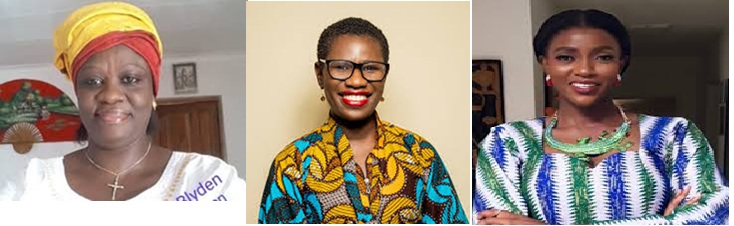
Yvonne Aki-Sawyerr, Dr. Sylvia Olayinka Blyden, and Zainab Sheriff represent three distinct pathways to power: technocratic governance, political activism rooted in media and policy, and grassroots mobilisation driven by popular culture and youth energy. Together, their emergence signals a defining moment not just for the APC, but for a country where women have historically played supporting roles rather than leading from the front.
At the centre of this unfolding political moment is Yvonne Aki-Sawyerr, the two-term Mayor of Freetown. Born on January 7, 1968, Aki-Sawyerr’s political brand has been built on competence, calm leadership, and visible results. A chartered accountant by training, she holds a Master’s degree from the London School of Economics and an economics degree from Fourah Bay College. Long before entering elective politics, she was already a familiar name in public service, co-founding the Sierra Leone War Trust in 1999 to support victims of the civil war.
Her national profile rose sharply during the post-Ebola period when she served as Delivery Team Lead for the President’s Recovery Priorities between 2016 and 2017. Many still credit her for helping stabilise coordination across ministries during one of the country’s most difficult recovery phases. However, it is her tenure as Mayor of Freetown that has truly defined her political identity.
Elected in 2018 and re-elected in 2023 with APC backing, Aki-Sawyerr has earned international recognition for her bold environmental and climate resilience agenda. Her flagship “#FreetownTheTreeTown” campaign, launched in response to the devastating 2017 mudslide that claimed over 1,100 lives, has seen very many trees planted across the capital. For many supporters, this initiative symbolises a leader who responds to tragedy with action, planning, and long-term vision.
Yet, critics argue that her strength is also her limitation. Much of her record is rooted in urban governance, raising questions about how well her experience would translate to national leadership, particularly in rural Sierra Leone. Internal APC tensions and disputes following the 2023 elections have also tested her political balancing skills. Still, among the three women, Aki-Sawyerr stands out as the candidate with the most tangible governance record and global networks.
If Aki-Sawyerr represents measured leadership and policy execution, Dr. Sylvia Olayinka Blyden embodies political fire, media influence, and ideological confrontation. Born on 1st October, 1971, Dr. Blyden is a trained and certified medical doctor now turned journalist and a political actor by instinct. She founded the Awareness Times newspaper and, at just 30 years old, became Sierra Leone’s youngest national political party leader in 2002, a feat that remains unmatched.
Her relationship with the APC deepened during the presidency of Ernest Bai Koroma, where she served first as Special Executive Assistant and later as Minister of Social Welfare, Gender and Children’s Affairs between 2016 and 2017. In that role, she positioned herself as a vocal advocate for women, children, and the vulnerable, while also earning a reputation as one of the most outspoken figures in national discourse.
Dr. Blyden’s supporters admire her courage, sharp intellect, and refusal to shy away from controversial issues. Her critics, however, see her as polarising, pointing to past confrontations and strong public commentary that have sometimes divided opinion. Still, few can deny her deep understanding of party machinery, party institutional memory, her experience at the highest levels of government, and her ability to dominate political conversation through the media.
Then there is Zainab Sheriff, the youngest of the trio and the most unconventional. Born on July 22, 1985, Sheriff is widely known as an actress, model, singer, entrepreneur, and activist, affectionately called “Mami Na Pawa” by her supporters. Unlike Yvonne Aki-Sawyerr and Dr. Blyden, she has never held formal political office. Instead, her influence comes from popular culture, social activism, and her ability to connect emotionally with ordinary Sierra Leoneans, especially young people.
In November 2025, Zainab Sheriff formally announced her intention to contest the presidency under what she calls the Lappa Movement, positioning herself as a symbol of bold change and female empowerment. She has openly criticised the ruling SLPP government and challenged President Julius Maada Bio on issues ranging from governance to social justice. Her rallies and public engagements have drawn significant attention, particularly among urban youth and women who feel excluded from traditional politics.
However, questions remain about her readiness for national leadership. Supporters see her as a fresh voice untainted by old political battles, while critics argue that passion alone is not enough to run a complex state. For Zainab to be taken seriously within the APC’s competitive internal processes, she will need to translate popularity into policy depth and organisational structure.
Beyond individual strengths and weaknesses, the bigger story is what these three women represent collectively. In a political culture long dominated by men, their emergence challenges entrenched norms and offers a powerful message to young girls and women across Sierra Leone: leadership is not reserved for one gender. At a time when the country continues to grapple with economic hardship, youth unemployment, and post-crisis recovery, inclusive leadership is no longer optional; it is essential.