By Sahr Ibrahim Komba
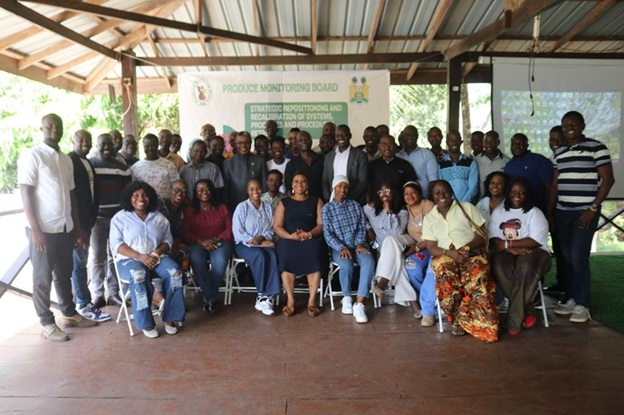
The Produce Monitoring Board (PMB) has taken a decisive step toward institutional transformation and enhanced national revenue generation following a two-day strategic repositioning and recalibration retreat held on the 13 and 14 January 2026 at the King’s View Resort, Sussex.
Speaking to the press, the Executive Chairman of the Produce Monitoring Board, Mr. Raymond Bob Katta, said the engagement was deliberately designed to strategically and programmatically reposition PMB as an effective, agile and premier commodities regulatory agency of government, capable of delivering on its broad national mandate.
According to Mr. Katta, the retreat provided a rare and critical space for institutional introspection, long-range planning, and strategic realignment, enabling PMB to rethink its operational approach, benchmark progress made under its reform and management agenda, and adopt work plans and process flows that are fit for purpose.
“This retreat is about creating the space for PMB to rethink and reposition itself, to recreate its institutional identity, define its niche in an increasingly crowded regulatory environment, and develop benchmarking mechanisms that will help us deliver efficiently, transparently, and accountably,” Mr. Katta stated.
The Executive Chairman disclosed that deliberations during the initial sessions focused heavily on PMB’s mandate, its adequacy, gaps, and future relevance. While participants agreed that PMB’s mandate is broad, there was a strong consensus that it requires expansion and strengthening to fully respond to emerging challenges in the produce sector.
He noted that although Sierra Leone currently has commodity-specific policies such as cocoa, cashew, and oil palm policies, the absence of a holistic, all-encompassing national produce sector policy remains a major constraint.
“We have legislation, but the policy framework is weak. A comprehensive produce sector policy will strengthen regulation, improve coordination, and enhance PMB’s ability to deliver greater value to government and farmers alike,” he explained.
Mr. Katta outlined the core strategic objectives of the retreat, which include reviewing PMB’s delivery and operational approaches to better align with its mandate, strengthening functional units such as Monitoring and Evaluation (M&E), research, project management, resource mobilization, communications and developing real-time performance benchmarking systems.
He emphasized that PMB is focused on recalibrating systems, processes, and procedures, while simultaneously increasing its visibility, rebranding the institution, and improving stewardship and transparency.
At the end of the retreat, expected outcomes include a realigned operational framework, a refined delivery approach responsive to contemporary challenges, a clear implementation plan to strengthen revenue mobilization and institutional capacity, and streamlined business support systems for improved efficiency.
“For us, value for money will be achieved when PMB is more responsive, accountable and impactful in revenue generation and service delivery,” Mr. Katta stressed.
In his statement, the lead facilitator for the retreat Dr. Emmanuel Gaima, Principal Executive Advisor to the President for the Public Service and Head of the Public Service at State House said his participation underscores the President’s strong interest in the revitalization of state institutions, including PMB.
He explained that beyond observing the process, his role was to provide technical backstopping to help PMB become more agile, productive, and strategically positioned.
“What is emerging clearly is the need for an overarching public sector policy, an update of the PMB Act which is slightly outdated, and a stronger institutional focus on technical competence, customer service, and core mandate delivery,” Dr. Gaima noted.
He added that PMB must increasingly orient its services toward farmers, exporters, and agribusinesses by strengthening advisory services, research, marketing and regulatory processes.
Dr. Gaima emphasized that PMB’s transformation aligns directly with President Julius Maada Bio’s vision of improving the economic sector while strengthening livelihoods, particularly for rural farming communities.
“Produce is central to our economy. When farmers are supported to increase productivity and income, communities become more self-reliant, tax revenues increase, and the government is better positioned to provide essential services,” he said.
He further explained that reforms will enable PMB to enhance its revenue contribution to the national treasury, explore greater self-financing mechanisms, and reinvest in research, staff development, and institutional growth thereby making PMB one of the government’s most efficient and sustainable revenue-generating institutions.
Participants at the retreat welcomed the initiative, describing it as transformative. Mr. Charles C. Campbell, Regional Manager East, said the retreat exposed institutional gaps and provided clarity on PMB’s mandate, revenue mobilization role, and service delivery responsibilities.
“This is a revolution of the new generation at PMB. Communication has improved, collaboration has strengthened, and the direction is very clear,” he said.
He revealed that regional offices, particularly in produce-rich areas such as the Eastern Province, will intensify farmer training on good agricultural practices to improve yield, quality, and revenue generation especially for cocoa, coffee, cashew, and palm oil.
Rugiatu Favour Kanu Marketing Manager at Produce Monitoring described the retreat as historic, noting that it was the first time staff from across the country were brought together for a working retreat to collectively define the future of PMB.
“Now that we know better, we will do better. The PMB is ready to work,” she assured.
With renewed focus, strengthened policy direction, improved operational systems, and strong backing from the Presidency, the Produce Monitoring Board is positioning itself as one of Sierra Leone’s most strategic institutions for service delivery and revenue generation.
The retreat marks a turning point in PMB’s journey toward becoming a modern, efficient, and results-driven institution capable of driving agricultural transformation, supporting farmers, and contributing significantly to national development.