
By Sahr Ibrahim Komba
The Inter-Religious Council of Sierra Leone (IRCSL) has endorsed the continued use of the First-Past-the-Post (FPTP) electoral system for general and local council elections in the country, describing it as the most suitable framework for strengthening democratic accountability and constituency-based representation in Sierra Leone.
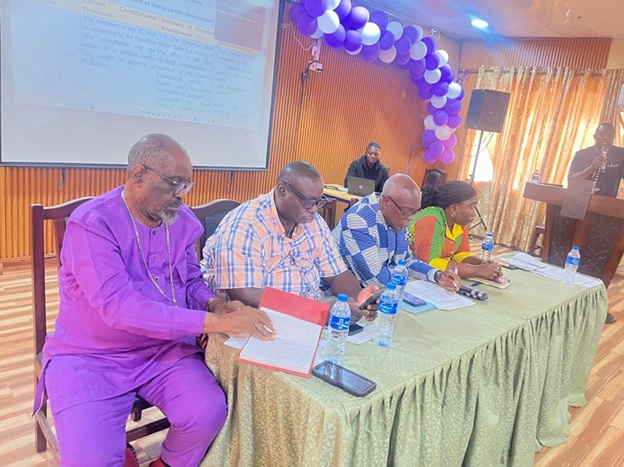
In a position paper submitted to the National Dialogue Conference held at the Bintumani International Conference Centre on July 17, 2025, the Council argued that the FPTP system provides clearer accountability between elected representatives and the citizens they serve.
The paper, titled “Affirming Democratic Accountability and Constituency-Based Representation: The Case for First-Past-the-Post in Sierra Leone,” was presented as part of ongoing discussions on electoral system reform in the country.
According to the Council, its position followed extensive consultations and participation in dialogue sessions organized by civil society groups, engagements with religious leaders under the Tripartite Committee, and discussions facilitated by the International Institute for Democracy and Electoral Assistance (International IDEA).
The Council acknowledged that Proportional Representation (PR) has certain advantages, particularly in translating votes into seats and encouraging broader political inclusion. It noted that the system can promote multi-party participation and create opportunities for greater representation of women, youth, and marginalized groups through party lists.
However, the Council cautioned that PR could pose challenges within Sierra Leone’s political context.
Among the concerns highlighted were the potential weakening of the direct relationship between voters and their elected representatives, the complexity of the system for voters, and the possibility of party elites dominating candidate selection processes.
While noting that PR may hold long-term value in certain political environments, the Council stated that Sierra Leone currently requires a system that ensures clear accountability, simplicity, and stable governance.
“The First-Past-the-Post system enables voters to choose individual candidates who are directly accountable to their constituencies,” the Council noted in the paper. “This direct relationship fosters a strong sense of responsibility between elected representatives and the people.”
The Council also emphasized the simplicity of the FPTP system, stating that it is widely understood by the electorate and easier to administer, particularly in a country where some voters may have limited formal education.
It further argued that FPTP tends to produce majority governments capable of governing with clarity and decisiveness—an important factor for maintaining political stability and sustaining development in fragile political environments.
The Council added that the system strengthens grassroots representation by encouraging candidates to remain physically present and responsive to the communities they represent, especially in rural districts.
Despite supporting the system, the IRCSL acknowledged that FPTP is not without limitations.
The Council noted that the system can sometimes produce disproportionate outcomes between votes received and parliamentary seats won, while also limiting representation for smaller political parties and minority voices.
To address these concerns, the Council proposed several complementary reforms within the FPTP framework. These include the introduction of reserved seats or quotas in political strongholds for women, youth, and persons with disabilities, strengthening internal party democracy, and ensuring transparent candidate selection processes.
The Council also called for deliberate national peace messaging during elections, emphasizing the critical role religious leaders can play in promoting peaceful political engagement.
In its conclusion, the IRCSL reaffirmed its commitment to supporting democratic governance and national cohesion in Sierra Leone.
The Council pledged to continue working with key electoral stakeholders, including the Electoral Commission for Sierra Leone, political parties, civil society organizations, and the international community to promote democracy, peace, and justice in the country.
The position paper was signed by Rev. Dr. Usman Jesse Fornah, General Secretary of the IRCSL, on behalf of the Council.