
By Sahr Ibrahim Komba
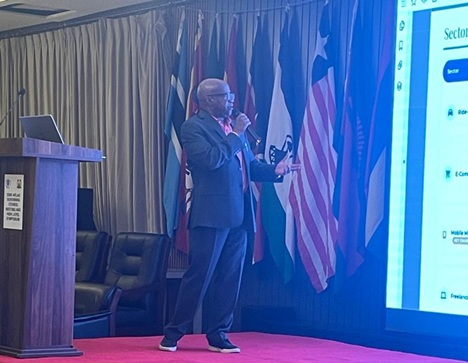
The President of the Sierra Leone Employers’ Federation (SLEF), Kobi Walker, has called for a balanced regulatory framework to guide the rapid expansion of the digital platform economy across Africa. He stressed that innovation must go hand in hand with stronger protections for workers. He made the statement during the 52nd Governing Council Meeting of the African Regional Labour Administration Centre (ARLAC) held in Freetown.
Speaking at the high-level labour forum attended by ministers and labour stakeholders from across the continent, Mr. Walker presented the employers’ perspective on decent work in the evolving digital labour market, highlighting both the opportunities and emerging risks associated with technology-driven employment.
Welcoming delegates to Sierra Leone, Kobi Walker briefly reflected on the country’s historical background, noting that the nation was named in 1462 by Portuguese explorer Pedro da Cintra, who described the mountainous peninsula as “Sierra Loya,” meaning “Lion Mountain.”
He also provided an overview of SLEF, which was established in 1962 as the national voice of business in Sierra Leone. The federation advocates for policies that promote sustainable enterprise development and decent work while representing employers across major sectors including mining, banking, petroleum, manufacturing, tourism, agriculture, construction, telecommunications and trade.
Over the years, SLEF has played a significant role in shaping labour reforms in the country, including participating in joint national negotiations, collaborating with the Sierra Leone Labour Congress, and contributing to social security legislation. The federation also helped facilitate the passage of the landmark Employment Act in 2023 and recently co-signed the Decent Work Country Programme aimed at strengthening labour standards nationwide.
A key focus of Mr. Walker’s address was the rapid growth of the platform economy—digital labour systems that connect workers with clients through mobile applications or web-based platforms. Examples include ride-hailing services such as Uber, Bolt and Yango, as well as e-commerce platforms like Jumia.
Globally, the gig economy was valued at approximately $556 billion in 2024 and is projected to exceed $2.1 trillion by 2033. Across Africa, the sector is expanding quickly, with an estimated 36 million gig workers and more than 230 million mobile money accounts supporting digital transactions.
He noted that the platform economy presents major opportunities for African countries with youthful populations. In Sierra Leone, where nearly 77 percent of citizens are under the age of 25, digital platforms could help tackle high levels of unemployment and underemployment while creating new pathways for entrepreneurship.
“The platform economy offers a vital pathway to formalization and decent work for our youth,” he said, emphasizing that digital platforms can support job creation, financial inclusion, market expansion and skills development.
He explained that sectors such as ride-hailing, e-commerce logistics and mobile money services are already transforming access to services while enabling small businesses to reach wider markets. The growth of mobile money services across Africa, including Kenya’s widely cited M-PESA system, demonstrates how digital payments can stimulate financial inclusion and economic activity.
Despite these opportunities, Mr. Walker warned that the rise of the gig economy also presents significant policy and regulatory challenges.
Among the key concerns are unclear employment classifications, limited social protection for platform workers, algorithm-based management systems, and the absence of collective bargaining mechanisms.
Most gig workers, he noted, operate without access to health insurance, pension coverage or injury protection, leaving them vulnerable during economic shocks. In Sierra Leone, only about 8.3 percent of the workforce is currently covered by the National Social Security and Insurance Trust.
Another issue raised was the increasing reliance on automated digital systems used by platforms to allocate tasks, determine pay rates and deactivate worker accounts. Walker called for greater transparency in these systems and the introduction of human review mechanisms to prevent unfair deactivations and build trust between workers and digital platforms.
Gender inequality in the digital labour market was also highlighted during the presentation. Although online gig work offers flexible opportunities for women, barriers such as limited digital access, safety concerns and unequal pay continue to persist. Across sub-Saharan Africa, women account for only about 27 percent of online gig workers.
To address these concerns, SLEF proposed a seven-point policy framework aimed at guiding the development of the platform economy across Africa. The recommendations include establishing clear employment classifications, strengthening social dialogue among governments, employers and workers, expanding social protection systems and promoting gender-inclusive policies within digital platforms.
The federation also urged African governments to align national policies with emerging global labour standards currently being discussed at the International Labour Organization, particularly those focused on protecting workers in digital labour markets.
“Businesses need clarity to innovate while ensuring fair play,” Mr. Walker said. “Innovation should not come at the cost of fairness and protection for workers.”
As digital platforms continue to reshape labour markets across Africa, employers stressed that policymakers must strike the right balance between enabling business innovation and ensuring decent working conditions for the growing number of workers entering the gig economy.