By Sahr Ibrahim Komba
In a significant step toward ending HIV as a public health threat, Sierra Leone has launched the Sierra Leone Population-based HIV Impact Assessment (SiLPHIA 2026), the first survey of its kind to provide accurate, household-level data on HIV prevalence, treatment coverage, and viral load suppression.
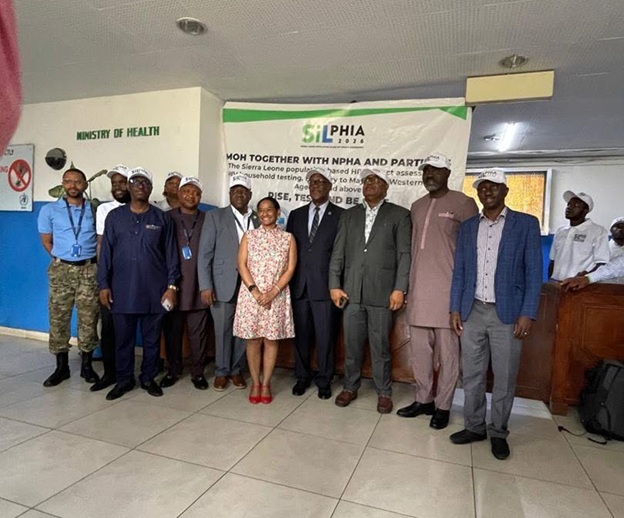
The launch brought together the Minister of Health, distinguished government officials, representatives from the U.S. Centers for Disease Control and Prevention (CDC), civil society, and members of the media. The survey, which began field operations on March 12, is already in motion, with 18 teams visiting households across 127 areas in the Western Area, offering HIV testing, counselling, and collecting crucial data.
Speaking at the launch, Minister of Health Dr. Austin Demby emphasized that the survey provides a clear understanding of the HIV epidemic in Sierra Leone, allowing health authorities to respond with precision. “For the first time, Sierra Leone will know exactly how many people in the Western Area are living with HIV, how many are on treatment, and how many have achieved viral suppression,” Dr. Demby said.
The survey is aligned with global targets to end HIV, particularly the UNAIDS 95-95-95 goals, which aim for 95% of people living with HIV to know their status, 95% of those diagnosed to be on treatment, and 95% of those on treatment to achieve viral suppression. The Minister noted that Sierra Leone has set an even higher national ambition of 98-98-98. Currently, the country reports 87% of people knowing their HIV status, 86% on treatment, and 63% achieving viral suppression, highlighting the critical need for intensified efforts.
“This survey is not just about measuring progress it is about driving action,” Dr. Demby added. “By understanding the epidemic, we can target interventions, close gaps, and ensure that no one is left behind.”
The Executive Director of the National Public Health Agency Brig-Gen Prof. Foday Sahr,highlighted the rigorous methodology of SiLPHIA and its long-term benefits. “More than 190 Sierra Leonean professionals, nurses, technicians, and team leads have been trained to implement this survey. Investments in laboratory infrastructure and workforce capacity will serve the country well beyond the survey itself,” he said.
Prof. Sahr stressed that the survey reinforces collaboration between the Government of Sierra Leone and international partners, particularly the U.S. CDC. “This effort demonstrates alignment, accountability, acceleration, and accompaniment the ‘Four As’ that guide our national HIV response,” he said, emphasizing that the systems and partnerships being strengthened are already improving service delivery.
Both government and international officials underscored that the success of SiLPHIA relies on community participation. Participation is entirely voluntary and strictly confidential, with testing conducted in the privacy of households. Individuals testing positive will be immediately linked to treatment.
Dr. Monique Foster, Country Director of the U.S. CDC in Sierra Leone, highlighted the global significance of population-based HIV assessments, which have transformed national HIV programs worldwide. “Sierra Leone now joins a group of countries using data not just to measure progress, but to drive it,” she said. “Every participant contributes directly to a stronger, more effective national HIV response.”
Experts emphasized that confidentiality and respect are critical to encouraging participation and ensuring people living with HIV receive timely care. Dr. Lakoh from Disease Prevention and Control Ministry of health noted that viral suppression not only protects the health of individuals but also prevents transmission, underscoring the importance of linking people to care and treatment.
SiLPHIA 2026 is both a foundation for action and a catalyst for progress already underway. By providing real-time, accurate data on HIV prevalence, treatment, and viral suppression, the survey equips Sierra Leone with the tools to sharpen strategies, target interventions, and accelerate progress toward epidemic control.
“SiLPHIA reflects a national commitment to data-driven decision-making, strong health systems, and improved health outcomes,” Dr. Foster concluded. “With continued collaboration and shared commitment, Sierra Leone is well-positioned to control and ultimately end HIV as a public health threat